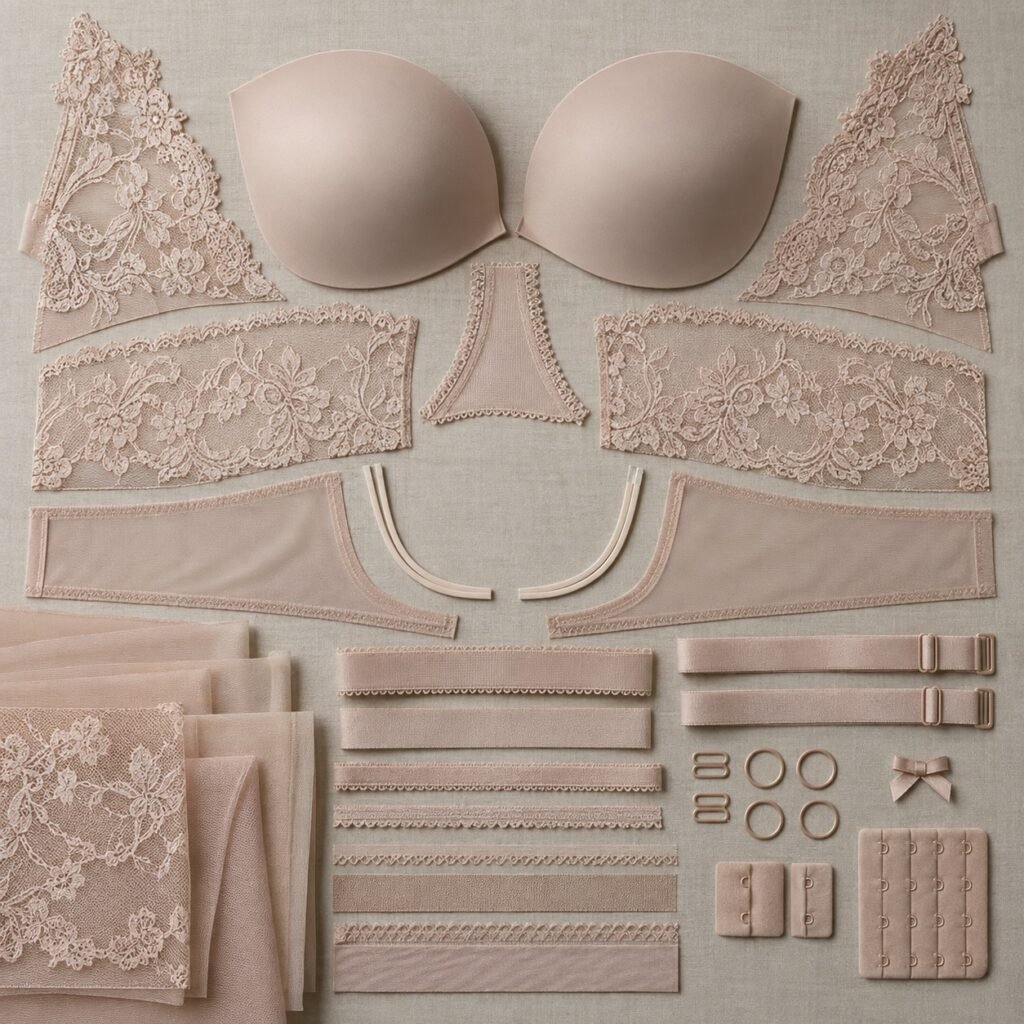
Direct answer: A bra bill of materials should identify every fabric, trim and packaging component by controlled reference, color, supplier, size group and consumption basis. It should also record approved substitutes, test requirements and change responsibility so production does not rely on visual similarity.
Map your bra bill of materials into component groups
- Body fabrics: cup, cradle, wing, lining, mesh and lace.
- Support: foam, wire, channeling, side bone and reinforcement.
- Elastics: underband, neckline, underarm, wing and decorative elastic.
- Hardware: rings, sliders, hooks, eyes and strap connectors.
- Identity: main label, care label, size mark and hangtag.
- Packaging: insert, bag, barcode label and carton.
Give every item a controlled identity
Record internal item code, supplier reference, composition, construction, width or thickness, color standard and approved sample date. A description such as beige lace is not enough when several laces have similar appearance but different stretch and recovery.
Attach a physical trim card or digital photo reference, but treat it as supporting evidence rather than the complete specification.
Control size-group differences
| Component | Possible size-group change |
|---|---|
| Wire | Shape and length by cup or style group |
| Strap | Width, elastic strength or hardware size |
| Hook-and-eye | Row count and width |
| Wing fabric | Reinforcement or power level |
| Foam cup | Mold series and thickness |
The BOM should show these transitions clearly rather than listing one component for the entire range.
Link BOM control to fit and quality
Material behavior is part of fit. Record stretch and recovery checks for key elastics and body fabrics, colorfastness requirements, surface or edge quality and any skin-contact review required by the project. When a material changes, identify which fit sizes and tests must be repeated.
Set a change-control rule
- Supplier proposes the change with reason and affected sizes.
- Buyer receives specifications and representative samples.
- Product, fit and quality teams review the affected functions.
- Required testing and fit samples are repeated.
- The revised BOM receives a new version and approval date.
Do not allow a verbal substitution at cutting or sewing because the original component is unavailable.
Consumption and costing discipline
Record consumption by size group and explain whether it is net pattern usage or an allowance that includes cutting loss and defects. Lace placement, pair symmetry and directional fabrics can create additional consumption. Separate one-time development or mold costs from recurring material and labor costs. This makes supplier quotations easier to compare and prevents later disputes over yield assumptions.
Color and lot approval
Approve fabric, lace, elastic and hardware under agreed lighting because matching components made from different fibers or finishes can appear different. Define which pieces must match closely and where controlled tonal variation is acceptable. Bulk teams should submit lot combinations before cutting when shade differences could affect paired garments or coordinated colorways.
Frequently Asked Questions
Is a trim card the same as a BOM?
No. A trim card shows physical references; the BOM also controls codes, suppliers, size groups, consumption, testing and revisions.
Should packaging be included in the bra BOM?
Yes. Labels, bags, inserts, barcodes and cartons are part of the delivered product configuration.
Why list components by size group?
Wire, strap, hook, foam and reinforcement can change across the range and must be controlled.
Can an equivalent elastic be substituted?
Only after stretch, recovery, appearance, fit and relevant quality checks are approved.
Who should own the BOM revision?
Assign one responsible product owner and require buyer-supplier approval for controlled changes.
Prepare a Quote-Ready Lingerie BOM
Share the style, size range and target construction. Ask CNBRAS to review your component references and proposed sample checkpoints before quotation.