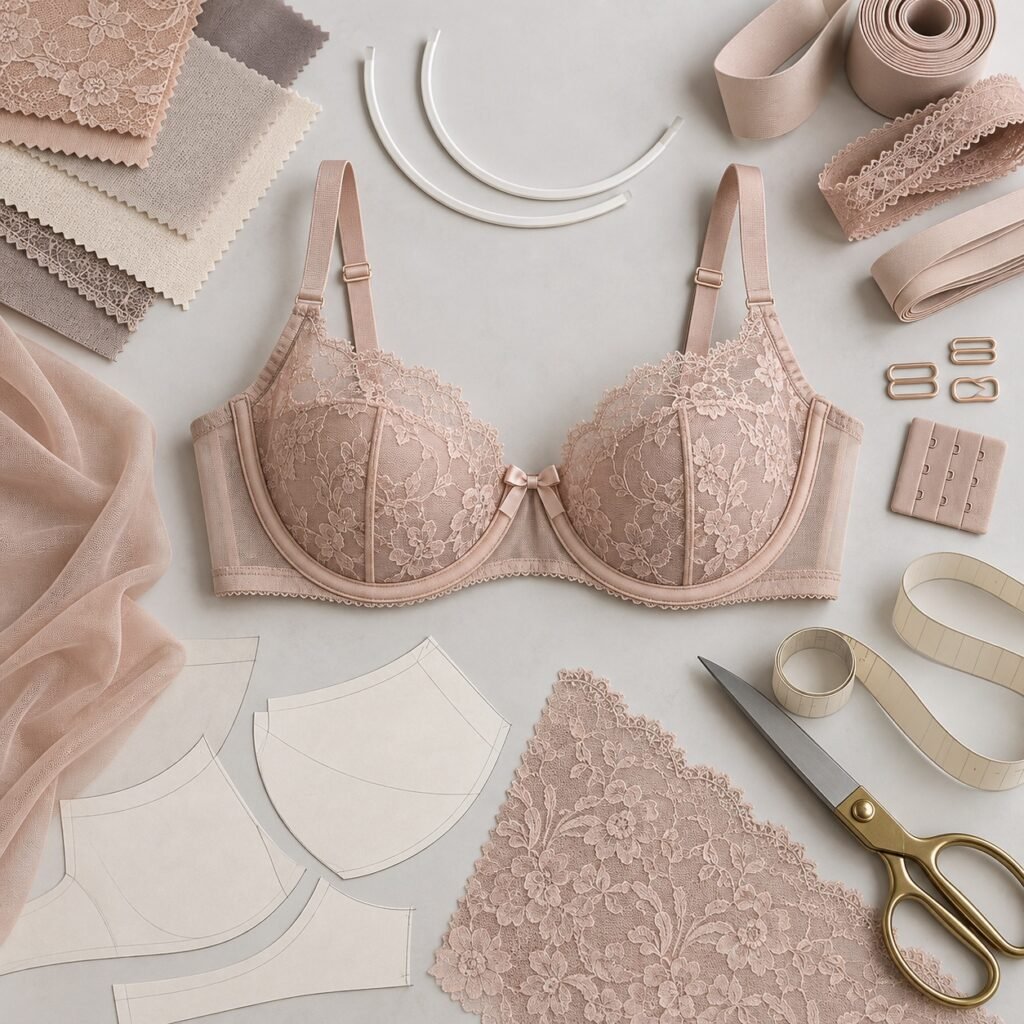
Direct answer: A private-label bra size range should be built from a defined target customer and one controlled base size, then validated through cup and band grading, fit samples in representative edge sizes, wear trials and a locked bill of materials. Copying a competitor size chart does not create a reliable fit system.
Define the wearer before the size chart
Start with market, age profile, support expectation, wearing occasion and price position. A soft lounge bra, everyday molded bra and fuller-support underwire style need different fit priorities. Record the intended band feel, cup coverage, neckline, strap placement and level of shaping before pattern work begins.
Choose a base size for your bra size range
The base size is the controlled development reference. From it, the pattern team grades band length, cup volume, cradle, wing, strap position and closure while protecting the style proportions. A single percentage increase is rarely sufficient across a broad size range. Larger cup groups may need adjusted wire, strap width, wing height or reinforcement.
Plan representative fit samples
- Base size for construction and initial fit.
- Small band and small cup edge of the range.
- Large band and representative larger cup.
- One middle size to check grading continuity.
- Any size group that uses a different wire, hook, strap or reinforcement.
The exact sample set depends on the range and construction. Approve measurements and on-body fit together.
Control materials during fit development
Lace stretch, power mesh recovery, elastic tension, foam behavior, wire shape and hook-and-eye dimensions all affect fit. Keep the material lot and component references controlled during sampling. If a component changes, repeat the relevant fit and wear checks rather than assuming the pattern alone controls the result.
Document approvals for bulk
- Measurement specification with tolerances.
- Approved pattern and grading table.
- Bill of materials by size group.
- Construction and stitch details.
- Fit comments and approved sample photos.
- Pre-production sample and packaging approval.
Frequently Asked Questions
Can one fit sample approve the complete size range?
No. The base size starts development, but representative band and cup extremes should be sampled to validate grading and component changes.
Why do larger cup sizes sometimes need different components?
Support and geometry change with size, which can require different wires, straps, wings, closures or reinforcement.
Can a brand use another company size chart?
A reference chart may support research, but the brand still needs its own target wearer, measurements, grading and fit validation.
What happens if the lace changes after approval?
Stretch, recovery and edge behavior may change fit, so the revised material should be reviewed and relevant samples repeated.
What should a private-label RFQ include?
Include style reference, customer profile, size range, base size, materials, support level, quantities, branding, packaging and target market.
Plan a Fit-Controlled Lingerie Program
Share the target customer, style direction and planned size range. Ask CNBRAS to review your development and sampling brief before quotation.